Shrine Girl (Miko) Wearing High Geta and Holding Robe Over Her Head representing Humanity (Jin), from the series of Five Virtues for the Katsushika Group (Katsushika goban), with poems by Shunhan, Shogan and Shofudai

- People
- Time
- Owner Organization

Humanity (Jin), series The Five Cardinal Virtues
![[A woman walking to the right, full-length portrait, facing left, wearing kimono and geta]](https://tile.loc.gov/storage-services/service/pnp/jpd/02700/02797_150px.jpg)
[A woman walking to the right, full-length portrait, facing left, wearing kimono and geta]
![[A person walking to the left, mostly obscured by an open parasol carried over the shoulder, wearing kimono and geta, and carrying a bag in right hand]](https://tile.loc.gov/storage-services/service/pnp/jpd/02700/02795_150px.jpg)
[A person walking to the left, mostly obscured by an open parasol carried over the shoulder, wearing kimono and geta, and carrying a bag in right hand]
Courtesan and Two Kamuro Representing Hotei, from the series Representations of the 7 Lucky Gods, by the Hanagasa Poetry Club
Woman Seated at Low Writing Table (Bundai), from the series Seven Designs for the Katsushika Circle (Katsushika shichiban tsuzuki), with poems by Shunryūsha Chikauo (Kaneuo) and Hakumōsha Kazumori (Banshu, Manshu)
Woman Holding a Box with Writing Tools/ Bunko, from the series Seven Designs for the Katsushika Circle (Katsushika shichiban tsuzuki), with poems by Bunyōsha Haruki, Bunkaen Harumitsu and Bun_en Tomomitsu
Woman Holding a Letter Box/ Letter Box (Fubako), from the series Seven Designs for the Katsushika Circle (Katsushika shichiban tsuzuki), with poems by Bunkeisha Shiomichi and Bunrinsha Matsunami

Makinoto, Konomo and Kanomo of the Chōjiya (Chōjiya uchi Makinoto, Konomo, Kanomo), from an untitled series of Five Festivals; representing the Doll Festival
Woman Holding a Tortoise-shaped Paperweight/ Paperweight (Bunchin), from the series Seven Designs for the Katsushika Circle (Katsushika shichiban tsuzuki), with poems by Bunritsuen _koto and Bunsaien Fudemaru
Woman Pulling the Wheeled Writing Table (Fuguruma) Rope, from the series Seven Designs for the Katsushika Circle (Katsushika shichiban tsuzuki), with poems by Bunkōsha Funazumi and Bunchōsha Hanahito (or Hanando)
COURTESAN WAKOKU AS OTOMONO KURONOSHI AND COURTESAN KASUAGANO AS ARIWARA NO NARIHIRA, FROM A SERIES REPRESENTING THE SIX IMMORTAL POETS
Woman Holding the Under the Cherry Blossoms (Hana no en) Volume of the Tale of Genji (Genji monogatari)/ Books (Bunsho), from the series Seven Designs for the Katsushika Circle (Katsushika shichiban tsuzuki), with poems by Rokuzōtei Hōba and Bungaen Tomom
Yang Guifei (Yōkihi) Viewing Cherry Blossoms from Verandah, from the series Cherry Trees for the Katsushika Circle, with poems by Shunrūtei Chikauo (Kaneuo) and Hakumōsha Kazumori (Banshu, Manshu)
![[Fukurokuju, the god of wisdom, wealth, long life, and happiness, one of the seven lucky gods, facing left, wearing robes and a hat, with a red-crowned crane standing to his right]](https://tile.loc.gov/storage-services/service/pnp/jpd/02700/02794_150px.jpg)
[Fukurokuju, the god of wisdom, wealth, long life, and happiness, one of the seven lucky gods, facing left, wearing robes and a hat, with a red-crowned crane standing to his right]
![[Two children wearing sailor outfits are playing with a balloon tethered to a Russian battleship, the balloon has burst revealing the head of a Russian admiral or czar and the battleship has been sunk, the Russian child, standing, pointing to the balloon, is crying, the Japanese child, sitting, is joyfully clapping]](https://tile.loc.gov/storage-services/service/pnp/jpd/00900/00982_150px.jpg)
[Two children wearing sailor outfits are playing with a balloon tethered to a Russian battleship, the balloon has burst revealing the head of a Russian admiral or czar and the battleship has been sunk, the Russian child, standing, pointing to the balloon, is crying, the Japanese child, sitting, is joyfully clapping]
![[Two children wearing sailor outfits are playing with a balloon tethered to a Russian battleship, the balloon has burst revealing the head of a Russian admiral or czar and the battleship has been sunk, the Russian child, standing, pointing to the balloon, is crying, the Japanese child, sitting, is joyfully clapping]](https://www.gumtree.com/static/1/resources/assets/rwd/images/orphans/a37b37d99e7cef805f354d47.noimage_thumbnail.png)
[Two children wearing sailor outfits are playing with a balloon tethered to a Russian battleship, the balloon has burst revealing the head of a Russian admiral or czar and the battleship has been sunk, the Russian child, standing, pointing to the balloon, is crying, the Japanese child, sitting, is joyfully clapping]

Shōgun Tarō Taira no Yoshikado Disarming Two Goblins, from the series Beauty and Valor in the Novel Suikoden (Biyū suikoden)
Araši Rikan II. jako Činzei Hačiró Tametomo

"Tsu": Narihira in the Snow at Ono, from the series "Tales of Ise in Fashionable Brocade Pictures (Furyu nishiki-e Ise monogatari)"

Nachtelijke regenbui in het Yoshiwara
Court Lady behind Curtain, with poems by Tamaboko no Michimaro, Arakane no Tsuchimaro and Oya no Atotsugi
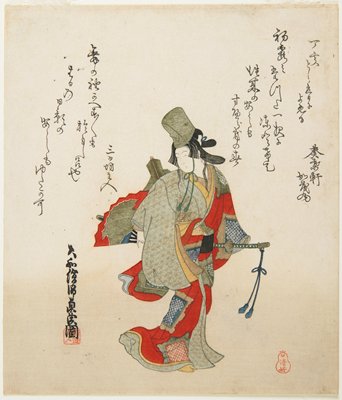
Shirabyoshi Dancer
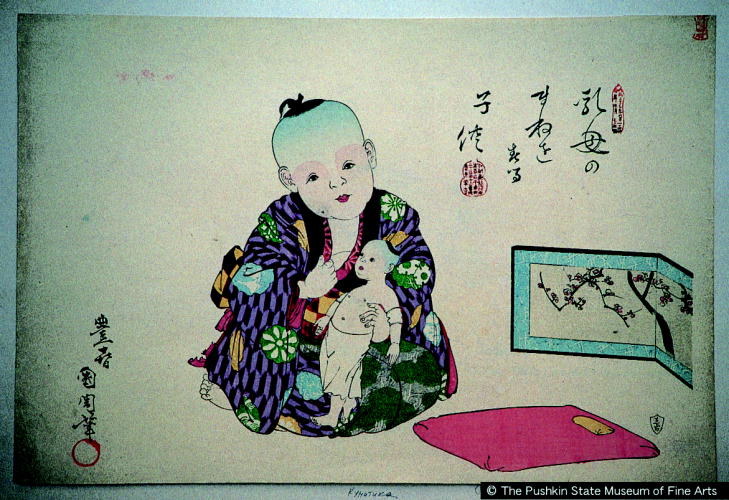
Child Imitating a Wet Nurse

Usugumo (Object); Nazorae Genji kyokun zue (Series)
Two Women and a Boy on a Bridge


Omi ; Furyu Mu-Tamagawa (Series)
![[Actor Print]](http://lapis.nichibun.ac.jp/image?did=8&pic=1&fid=G130151702.jpg)
[Actor Print]

Manjiya Yatsuhashi Segawa Kikunojo

Japan Banzai : 100 Selections 100 Smiles(Album) (Russo-Japanese War)
Yamato, from the series Comparisons of Tales (Monogatari awase)

A Cricket
WOMAN HOLDING BASKET
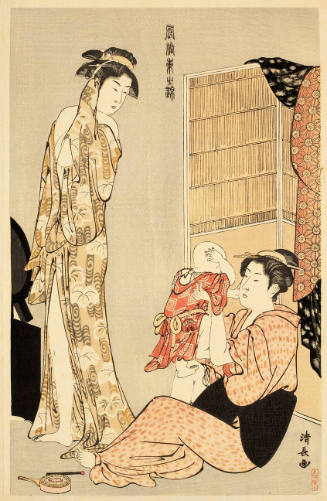
Modern Reproduction of “Woman in Bathrobe and Mother Playing with Baby", series Current Manners in Eastern Brocade
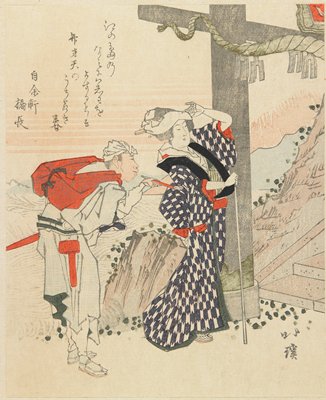
Woman and Man at Entrance Gate of Enoshima
Actor Ichikawa Yaozō AS A SHITEI
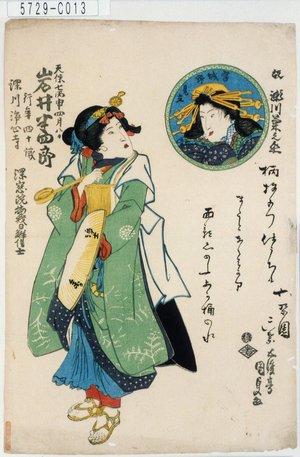
「見立宮城野 故瀬川菊之丞」「岩井半四郎」
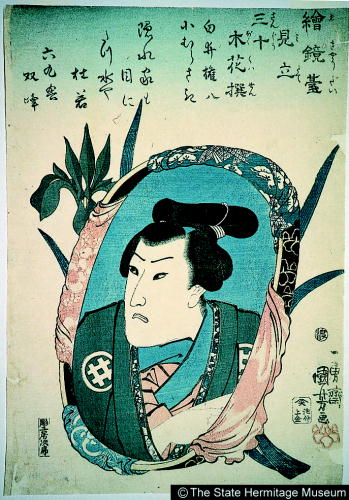
Ekyoodai mitate sanjuubokkasen Shirai Gonpachi/ Komurasaki

Educational Picture:Foreigner

Ariwara no Narihira, from the series "Fashionable Children as the Six Immortal Poets (Furyu kodakara rokkasen)"
Hōjō Yasutoki (Azuma kagami), from the series Twenty-Four Japanese Paragons of Filial Piety for the Honchō Circle (Honchōren honchō nijūshikō), with poems by Ikenoya Kamemori and Takinoya Kiyome
Last Updated:
Uploaded: 2021-07-21