
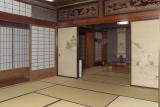
Rooms of the Old Shoin, Viewed from the East; the Second Room in the Middle; Beyond, the Main Room, Left, and the Spear Room, Right

- People
- Time
- Owner Organization

Second Room, Left, and the Main Room, Right, of the Middle Shoin, Viewed from the Northeast

Main Room, right, and the Second Room, left, of the Middle Shoin

Rooms of the Old Shoin, viewed from the east

Middle Shoin, Right, and the New Goten, left, Viewed from the East; Broad Veranda of the Music Suite in the Middle

Entrance Room of the Shôiken Pavilion, Viewed From the North Veranda; Middle Room Beyond

Middle Shoin, and the New Goten, viewed from the east

Tokonoma in the Main Room of the Gepparô Pavilion, viewed from the southeast

Tokonoma in the Main Room of the Shôiken Pavilion, Viewed from the West

The Actor Sawamura Sojuro III (right), in His Dressing Room in Conversation with the Actor Segawa Kikunojo III (left)
![Old Man of the Southern Pole (under tree), Lü Dongbin (left), Zonglin Quan (center), Xue Shenwong (right) [center left of the set Daoist Immortals]](https://2.api.artsmia.org/18574.jpg)
Old Man of the Southern Pole (under tree), Lü Dongbin (left), Zonglin Quan (center), Xue Shenwong (right) [center left of the set Daoist Immortals]

The Actors Nakamura Kashiwagi as a Wakashu (second from right), and Three Unidentified Actors as Yakko

The Actors Sawamura Kijuro I as Ikazuchi Shinno, Prince of Thunder (far left), Ichikawa Danjuro V as the Buddhist Deity Fudo (second from left), Nakamura Sukegoro II as Seitaka Doji (second from right), and Bando Mitsugoro I as Kongara Doji (far right), in the Play Fuki Kaete Tsuki mo Yoshiwara (Rethatched Roof: The Moon also Shines Over the Yoshiwara Pleasure District), Performed at the Morita Theater in the Eleventh Month, 1771

The Actors Ichikawa Danjuro V as Gokuin Sen'emon (right), Bando Mitsugoro I as An no Heibei (center), and Nakamura Sukegoro II as Kaminari Shokuro (left), in the Play Hatsumombi Kuruwa Soga, Performed at the Nakamura Theater in the Second Month, 1780

The Actors Ichimura Uzaemon IX as Shume no Hangan Morihisa (right), and Sanogawa Ichimatsu II as Chujo (left), in the Play Edo no Hana Wakayagi Soga, Performed at the Ichimura Theater in the Second Month, 1769
![[Russian soldier on horseback, carrying a sword in right hand, a spear in left hand, and a rifle mounted on his chest with a string extending from the trigger to his mouth]](https://tile.loc.gov/storage-services/service/pnp/jpd/01000/01009_150px.jpg)
[Russian soldier on horseback, carrying a sword in right hand, a spear in left hand, and a rifle mounted on his chest with a string extending from the trigger to his mouth]
![[Russian soldier on horseback, carrying a sword in right hand, a spear in left hand, and a rifle mounted on his chest with a string extending from the trigger to his mouth]](https://www.gumtree.com/static/1/resources/assets/rwd/images/orphans/a37b37d99e7cef805f354d47.noimage_thumbnail.png)
[Russian soldier on horseback, carrying a sword in right hand, a spear in left hand, and a rifle mounted on his chest with a string extending from the trigger to his mouth]

The Actors Tomizawa Hanzaburo II as Nagoya Sanzaemon (often called Sanza) (right), Nakamura Juzo II as Fuwa Banzaemon (center), and an Unidentified Actor as the Pickpocket Matsumoto Daishichi (left), in the Play Fuki Kaete Tsuki mo Yoshiwara, Performed at the Morita Theater in the Eleventh Month, 1771

The Actors Kasaya Matakuro II as Nobuyori Disguised as the Yakko Gunnai (right), and Miyazaki Hachizo as the Lay Monk Hambyo Nyudo (left), in the Play Nue no Mori Ichiyo no Mato, Performed at the Nakamura Theater in the Eleventh Month, 1770

The actors Ichikawa Danjuro V as a skeleton, spirit of the renegade monk Seigen (left), and Iwai Hanshiro IV as Princess Sakura (right), in the joruri "Sono Omokage Matsu ni Sakura (Vestiges of Pine and Cherry)," from part two of the play "Edo no Hana Mimasu Soga (Flower of Edo: An Ichikawa Soga)," performed at the Nakamura Theater from the first day of the second month, 1783

The Actors Ichikawa Danzo IV as Arakawa Taro Takesada Disguised as the Palanquin Bearer Tarobei (right), and Ichikawa Danjuro V as Abe no Sadato Disguised as the Pilgrim Kuriyagawa Jirodayu (left), in the Play Godai Genji Mitsugi no Furisode, Performed at the Nakamura Theater in the Eleventh Month, 1782

The Actors Nakamura Nakazo I as Onmaya Kisanda Dressed as Kakubei the Lion Dancer (Kakubei-jishi) (right) and Segawa Kikunojo III as Shizuka Gozen (left), in the Dance Sequence "Myoto-zake Kawaranu Nakanaka" (Everlasting Harmony of the Marital Cup), from the Second Part of the Play Chigo Torii Tobiiri Kitsune (Heavenly Child—The Fox Leaps Through the Shrine Gate), Performed at the Ichimura Theater in the Eleventh Month, 1777

Nakamura Utaemon IV as Nuregami Chōgorō (a, right panel); Mimasu Daigorō IV as Oseki and Kataoka Ichizō I as the Wine Seller Kambei (b, center panel); and Jitsukawa Ensaburō I as Hanaregoma Chōkichi (c, left panel)

The Actors Osagawa Tsuneyo II (right), Ichikawa Monnosuke II (center), and Segawa Kikunojo III (left), Possibly as Misao Gozen, Matsuya Soshichi, and the Courtesan Kojoro of Hakata, in the Play Chiyo no Hajime Ondo no Seto (Beginnings of Eternity: The Ondo Straits in the Seto Insland Sea) (?), Performed at the Kiri Theater from the Twenty-seventh Day of te Seventh Month, 1785

The Actors Ichikawa Monnosuke II as Karigane Bunshichi, Bando Mitsugoro I as An no Heibei, Ichikawa Danjuro V as Gokuin Sen'emon, Nakamura Sukegoro II as Kaminari Shokuro, and Sakata Hangoro II as Hotei Ichiemon (right to left), in "Gonin Otoko" (Five Chivalrous Commoners), an Interlude in Part Two of the Play Hatsumombi Kuruwa Soga (A Soga Drama on the First Festival Day in the Pleasure District), Performed at the Nakamura Theater from the First Day of the Second Month, 1780

#152, Katsura Villa
Rooms of the Old Shoin, viewed from the east
Tokonoma in the Main Room of the Shôiken Pavilion, Viewed from the West
Tokonoma in the Main Room of the Gepparô Pavilion, viewed from the southeast

Liaison Corridor Connecting the Old Shoin with the New Goten, Viewed from the South
でい

Nikkoutamozawagoyoutei kougougozasho

Untitled (View of the Third Room from the Second Room of the Shoiken)

Untitled
Second Room, Left, and the Main Room, Right, of the Middle Shoin, Viewed from the Northeast

Untitled

旅館寿亭 水雲閣

Kyuusuzukikejuutaku butsumazashiki

Garden Viewed from the western part of the Shokintei Pavilion
Entrance Room of the Shôiken Pavilion, Viewed From the North Veranda; Middle Room Beyond

Kneeling Entrance, the Tea Room of the Shôkintei Pavilion, Viewed from the Northeast
Main Room, right, and the Second Room, left, of the Middle Shoin

Untitled
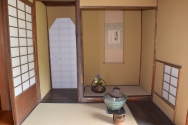
勝願寺茶室

風呂場

Untitled

床の間

「〔民家蚕業之図〕」

床の間
Last Updated:
Uploaded: 2021-07-21